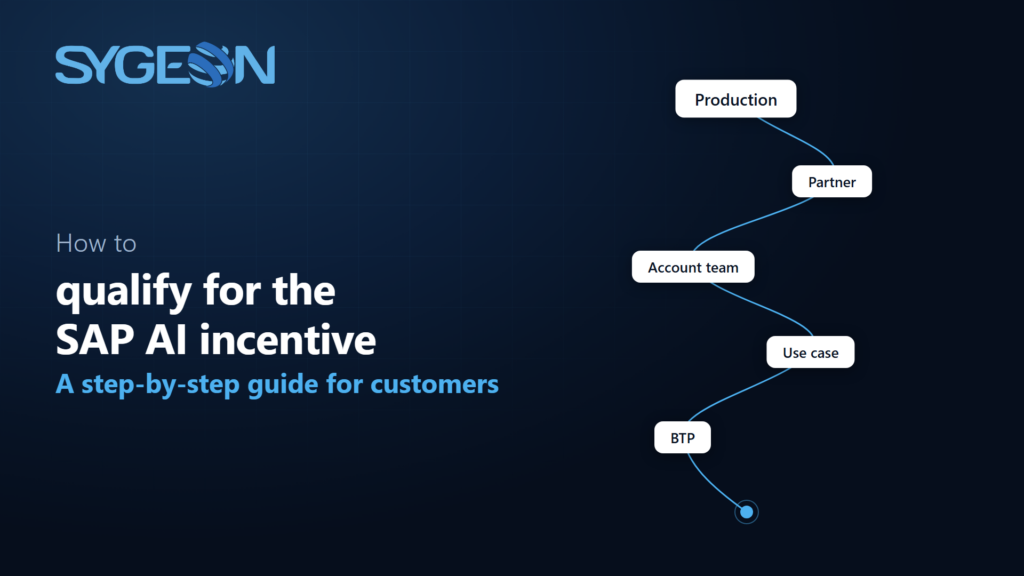
In June 2026, SAP put €100 million on the table to fund AI projects delivered by partners for its customers. The money is real, and so is the state of the market it targets: SAPinsider research from mid-2026 found that 74 percent of SAP customers were still identifying or experimenting with AI, or had no plans at all. The program exists precisely because so few projects reach production on their own.
The gap between hearing about the program and running a funded project is a sequence of steps, and most of them happen on your side before SAP or any partner enters the picture. This guide walks through that sequence. If you want the background on what the program is and why SAP created it, start with our overview of the SAP AI incentive and come back here for the how.
What the program funds
The SAP Business AI Partner-Led Adoption Incentive, announced at SAP Sapphire 2026, funds the delivery of AI projects by qualified partners for approved customers. The scope covers activation of SAP-built AI agents and assistants, custom agents built in Joule Studio, and AI-powered applications and workflows on SAP Business AI Platform. One point deserves emphasis before anything else: SAP pays the approved partner for the delivery work. Your company receives a working solution deployed in your SAP environment, together with adoption support, rather than a cash payment or a license discount. Approval and funding decisions rest solely with SAP.
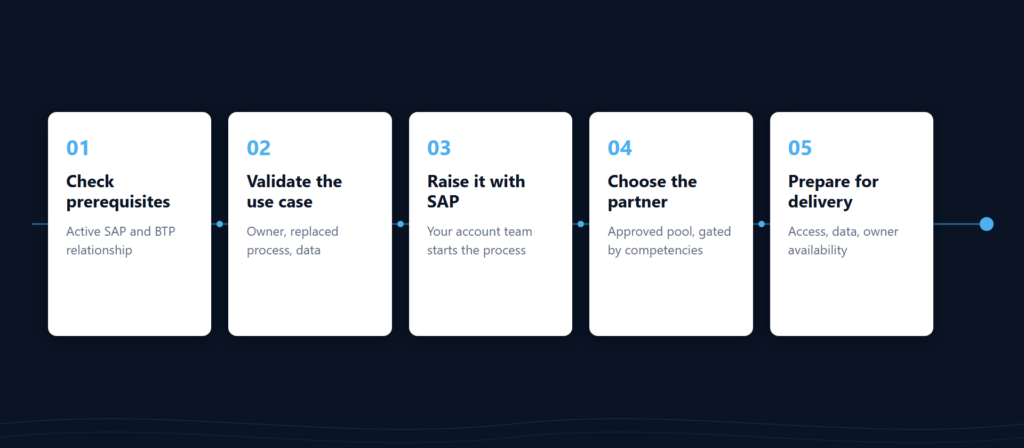
Step 1: check the two prerequisites you control
Qualification starts with readiness, and readiness has two components you can verify this week without talking to anyone outside your company.
First, you run SAP with an active commercial relationship, and that includes SAP BTP. A commercial BTP commitment is part of the program’s eligibility, so if you are already running workloads on BTP under an active agreement, you are squarely in the target group. If you are not on BTP yet, do not treat that as a detail to sort out later: raise it with your SAP account team first, because they can tell you what your specific situation requires before you invest time in anything else.
Second, you have a use case worth deploying. The program funds production deployments, and a use case qualifies for that ambition when it addresses a process you can measure. “We want to explore AI” is not a use case. “Our AP team manually matches 4,000 invoices a month and the exceptions queue takes three days to clear” is one.
If both boxes are checked, you are further along than most of the market.
Step 2: validate the use case before anyone external sees it
A use case that survives an honest internal review will survive the program review too. We recommend three pass/fail questions, and all three must pass:
- Who will own it?
A named person who is accountable for the agent’s output after go-live, with the mandate to change or switch it off. If the answer is a committee or “IT”, the use case fails this test.
- What does it replace?
A specific manual activity, decision, or delay with a cost you can estimate. If the agent adds a capability nobody asked for, it will be measured against nothing and defended by no one.
- Where does the data live?
The agent needs read access to specific systems and documents. If that data is scattered, unowned, or of uncertain quality, fix the foundation first. We have written before about why foundations decide AI outcomes, and the incentive changes nothing here: an agent deployed on weak data will fail regardless of who paid for the deployment.
This internal validation costs you a workshop and an afternoon. It saves you weeks of back and forth later, and every conversation that follows starts from a concrete case instead of a general interest in AI.
Step 3: raise it with your SAP account team
The program runs on SAP’s side of the fence. Your SAP account executive is the person who puts your project into the process, so the practical move is a short message: we have a validated AI use case, we understand it may fit the Business AI adoption incentive, who do we talk to.
If you have not heard about the program from your account team yet, that is normal and means nothing about your eligibility. Account teams cover many customers, and the ones who raise their hand get the attention. Nothing stops you from talking to a delivery partner earlier to sharpen the case, and it often speeds things up, but the formal role of the partner begins at delivery. The conversation that puts your project into the program belongs to you and your SAP account team.
Two expectations to set internally. SAP validates every proposed project, and only validated projects receive funding. The budget is also fixed, so the practical window closes earlier than any calendar suggests, and postponing to a quieter quarter carries a real risk that the money is allocated by the time you return.
Step 4: choose the delivery partner
The program requires delivery by an approved partner. In practice, expect SAP to propose partners from the approved pool, and know that you can bring your own preferred partner as long as they are part of the program. The pool itself is not a random directory: entry is gated by competencies such as SAP Business AI Platform Expert, which take delivered projects and certified people to earn. Within that pool, three criteria matter more than logo size.
The first is platform depth. The work happens on SAP BTP: Joule Studio, SAP Build, the AI services underneath. Ask the partner what they have shipped on the platform, and ask for specifics rather than slideware. If your team has a particular architecture in mind, an experienced partner will also tell you early whether it fits the program’s shape, since qualification of any specific project is decided by SAP case by case.
The second is integration competence. Every useful agent reads from and writes to your existing systems, and a partner who treats integration as an afterthought will deliver an agent that performs well in a demo and does nothing in production.
The third is honesty about fit. A partner who tells you which use cases to avoid is worth more than one who says yes to everything. The incentive pays partners for delivery, which creates an obvious temptation to inflate scope, so you want the partner who argues for the smaller, well-bounded project.
Sygeon is a formally onboarded delivery partner in the program, with the SAP Business AI Platform Expert competency behind it. Our view on where to start is on the SAP AI incentive page, and we are happy to pressure-test a use case before you take it to SAP.
Step 5: prepare for a three-month clock
After approval, initial deployment is expected within roughly three months, and well-bounded use cases move considerably faster. That pace is a feature of good AI projects in general, and it has consequences for your preparation.
Line up system access, test data, and the process owner’s calendar before the project starts, because a funded project that stalls on internal access requests burns its schedule on your side of the fence. It also pays to bound the first scope precisely, since the program rewards a working solution in production. A bounded scope can still be ambitious. The program covers everything from activating SAP-delivered agents to custom agents and full workflow applications built for your processes, and the further you go toward custom, the more the funding does for you, because that is the work you would otherwise pay for entirely yourself. A well-defined custom workflow with a named owner is a better use of the program than a token activation you would have done anyway.
Frequently asked questions
Do we qualify for the SAP AI incentive?
If you run SAP with an active commercial relationship, including a BTP commitment, and have a production-ready use case, you are a candidate. The exact commercial conditions are between you and SAP, and final qualification and funding decisions rest solely with SAP, on a per-project basis.
Is the incentive a discount or a payment to our company?
Neither. SAP pays the approved partner for delivering your project. Your company receives the deployed solution and adoption support without carrying the partner delivery cost.
Can the incentive cover an AI pilot?
The program targets production deployments rather than experiments. A well-bounded first use case deployed to production is the intended shape. If what you have in mind is a throwaway proof of concept, reshape it into a small production scenario first.
How do we apply?
There is no public application form. The path runs through your SAP account team, and the delivery partner formally enters once a project moves toward delivery. Start with the internal validation in step 2, then contact your account team. Consulting a partner informally before that conversation is allowed and often useful.
How long does approval take?
SAP does not publish processing times, and we will not invent one. What you control is arriving prepared: a validated use case with a named owner moves through any review faster than an idea.
We are on ECC, not S/4HANA. Is this for us?
The AI capabilities in scope run on SAP BTP, and BTP operates alongside ECC as well as S/4HANA. An agent or application on BTP working with data from an ECC system is an established pattern, and we walk through the options in our map of AI in SAP, including a section written specifically for ECC customers. Whether a given project qualifies for funding is decided by SAP per project, so treat an ECC footprint as a design consideration and validate the use case the same way.
When does the program end?
The budget is fixed and shrinks with every approved project, so treat the practical deadline as earlier than any published date. If you intend to participate, start the internal validation now.
Where to start
The whole path condenses to one instruction: validate one use case this week using the three questions above, then make two calls, one to your SAP account team and one to a delivery partner. If you would like the second call to be with us, book a 30 minute conversation and bring the use case. We will tell you honestly whether it is fundable, and if it is not, what to fix first.