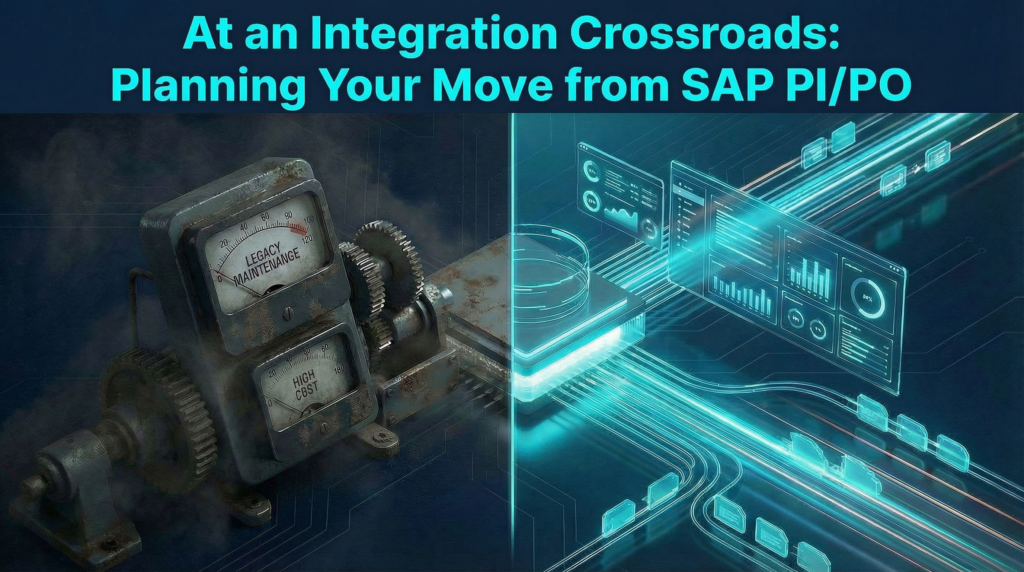
Support for SAP PO ends by the end of 2027, with extended maintenance available until 2030. However, opting for extended support typically comes with a significant price tag, adding a surcharge of around 2 to 4 percentage points on top of your existing maintenance base.
The 2030 deadline is official and non-extendable. The fundamental reason is that support for the underlying SAP NetWeaver Java stack will end that year, making it impossible for SAP to guarantee security, compliance and patches.
So you are at a crossroads right now. You need to plan your strategy for the upcoming months. Your business is not standing still in one place, the world is moving and changing rapidly and your architecture is expected to keep up.
What are the options you have right now?

Do nothing and keep SAP PI/PO running
You will be able to do it for at least the next four years. All existing integrations will be unaffected and new ones will of course still be possible to implement. But think about the hidden costs and business factors. Developing something in SAP PI/PO takes time – a point supported by a Forrester TEI report, which notes that legacy integration tools are complex to manage and point-to-point application integrations are time-consuming to build and difficult to maintain. If you need to connect new SaaS systems using modern methods, usually multiple workarounds are needed to make it happen. This is not to mention the complexity of connecting recently emerged AI tools, implementing API management or moving towards Event-Driven Architecture.
Additionally, the extended maintenance will add a premium to your standard fees, increasing your total cost of ownership significantly without delivering new features.
Finally, have you recently met any graduate who wants to learn a legacy tool like SAP PI/PO? Me neither. So who will be building, changing and supporting all these critical integration flows in the future?

Start small with SAP Integration Suite
You do not have to plan a big bang migration from the start. Start with small steps. The first one will be setting up your SAP BTP account. At Sygeon, we can help you configure this initial landscape properly from day one. From a business perspective, having a trusted partner at this initial touchpoint ensures your architecture is scalable from the ground up, whether you use Pay-As-You-Go or BTPEA models.
You have probably heard that SAP Integration Suite tenants are expensive, roughly 5k EUR per month. But there is good news. SAP offers a Free Tier. You can start building your new flows or try migrating simple ones from PI/PO to get familiar with the platform. After 90 days, you can reset it and continue testing. Once you are ready to start in production – because Free Tier cannot be used in prod – you can move to the paid version (always check with your SAP Partner or SAP representative to see if you are eligible for any discounts). From here, you can focus solely on new developments using SAP IS or gradually move existing SAP PI/PO integrations. It all depends on your timeline, the number of integrations and planned projects. It might even happen that at some point in the future, all legacy PI/PO integrations will be naturally decommissioned.
Start planning the migration
Here you will need proper tools and expertise. Start with the SAP Migration Assessment Tool to evaluate your landscape and find a partner with the proper experience who will guide you through all the phases, from planning to a successful go-live. I still do not suggest doing it in one shot. Rather, plan migration batches that make sense from a business or architecture perspective. You can group processes or focus on integrations touching a particular system.

If not SAP IS, then what?
Your choices are not limited to SAP IS. Actually, there are some very viable alternatives. One of them is Workato. Apart from being recognized as a Leader in the Gartner Magic Quadrant for iPaaS for its execution speed and low-code approach, it consistently receives excellent feedback from customers on platforms like Gartner Peer Insights for its intuitive design and rapid time-to-value. Workato fully supports SAP integrations and offers multiple ready-to-use accelerators. There were already successful, large-scale migrations from SAP PI/PO to Workato that took place. For example, organizations adopting Workato for their SAP PI/PO migration report up to 4x faster project delivery compared to traditional platforms and leading healthcare enterprises have successfully replaced over 100 legacy workflows using its robust, cloud-native architecture.
At Sygeon, we can help you navigate through this process and find the best option that suits your company and processes, allowing you to build a future-proof integration foundation.
Where are you right now on this integration crossroad? Book a time with our expert to discuss your strategy and find the smartest path forward for your architecture.